[wp_ad_camp_1]
aka … Water weasel, Don Felipe weasel (after Philip Hershkovitz who made numerous contributions to South American fauna in the 1950s).
Appearance
Until they were identified as a separate species in 1996, several Colombian weasels were mistaken for the long-tailed weasel (Mustela frenata).
In a paper entitled “Phylogeographic patterns of mitochondrial differentiation in the long-tailed weasel, Mustela frenata“, produced at the 87th Annual Meeting of the American Society of Mammalogists, it was stated that “the first mitochondrial sequences of the Colombian weasel (Mustela felipei), used in outgroup comparisons suggest that the Colombian weasel might prove a closer sister taxon to the long-tailed weasel (Mustela frenata) than the traditional sister taxon, the American mink (Neovison vison).
It’s probably the rarest carnivore in South America and virtually nothing was known about its distribution, its status or its ecology prior to 1989.
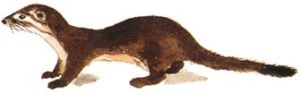
The Colombian weasel is approximately 22cm (9 inches) long, and one weighed 138g (5oz).
As it has webbing between its toes, scientists think that this weasel may be aquatic.
Distribution & Conservation Status
Western Colombia & northern Ecuador.
The Colombian weasel lives in the mountain forests of the Andes, from 1500 to 2000m (4921 to 6562ft) over sea level. The climate is subtropical.[wp_ad_camp_2]
It’s listed on the IUCN Red List of Threatened Species as Endangered (EN) and it’s considered to be facing a very high risk of extinction in the wild.
There has been extensive deforestation in the area where this particular weasel has been found but, to date, it hasn’t been established whether this is causing an adverse effect on it or not.
Diet
Due to the lack of information about this rare weasel, it is assumed that, being a carnivore, the animal has a similar diet to its weasel cousins, i.e. small mammals, insects, etc. However it’s also suspected that, because of its webbed feet, the Colombian weasel might also include fish in its diet.
Habitat
These weasels are considered to be riparian, which means that they probably live near the banks of a natural course of water.
How to say Colombian Weasel in different languages
- Arabic: ابن عرس كولومبي
- Czech: lasice kolumbijská
- Danish: columbiansk væsel
- Dutch: colombiaanse wezel
- French: belette colombienne / belette de Don Felipe
- German: kolumbianischer wiesel
- Hungarian: kolumbiai menyét
- Japanese: コロンビアイタチ
- Lithuanian: kolumbinė žebenkštis
- Portuguese: doninha-colombiana
- Russian: Колумбийская ласка
- Spanish: comadreja de Felipe / comadreja colombiana
- Swiss: kolumbienwiesel
- Turkish: kolombiya gelinciği
- Vietnamese: Chồn Colombia
[wp_ad_camp_3]
Return from Colombian Weasel (Mustela felipei) to All About Ferrets